COMFORT: Artist research

Mike Kelley

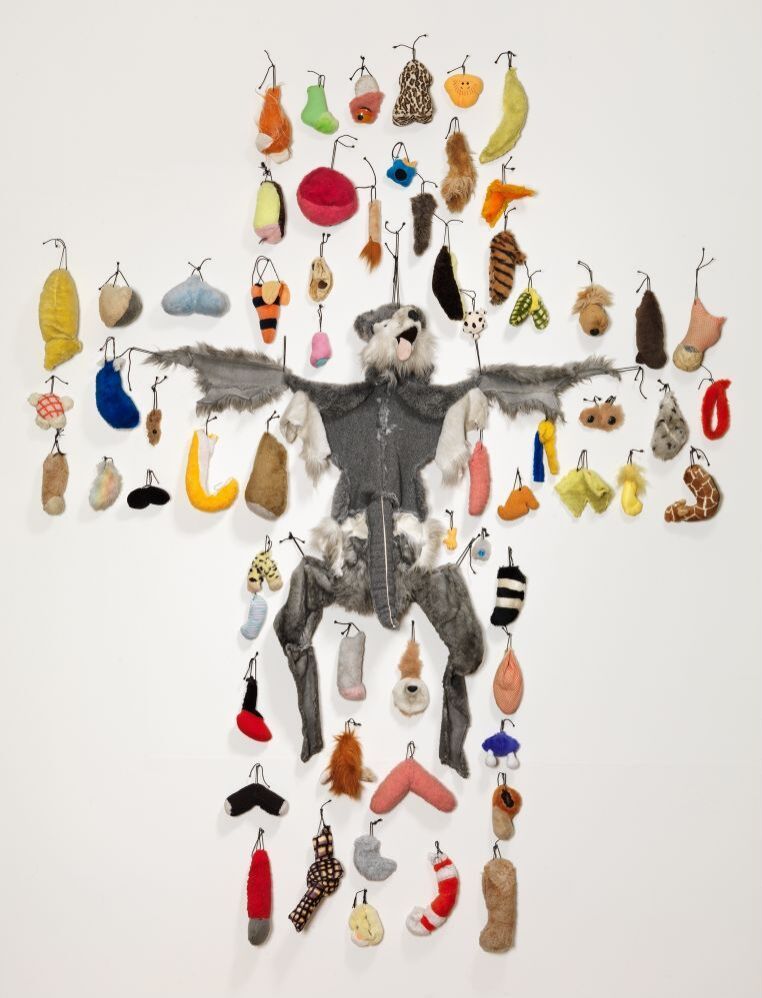
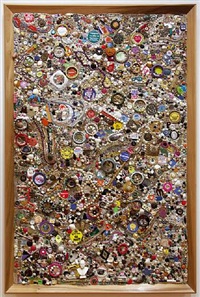
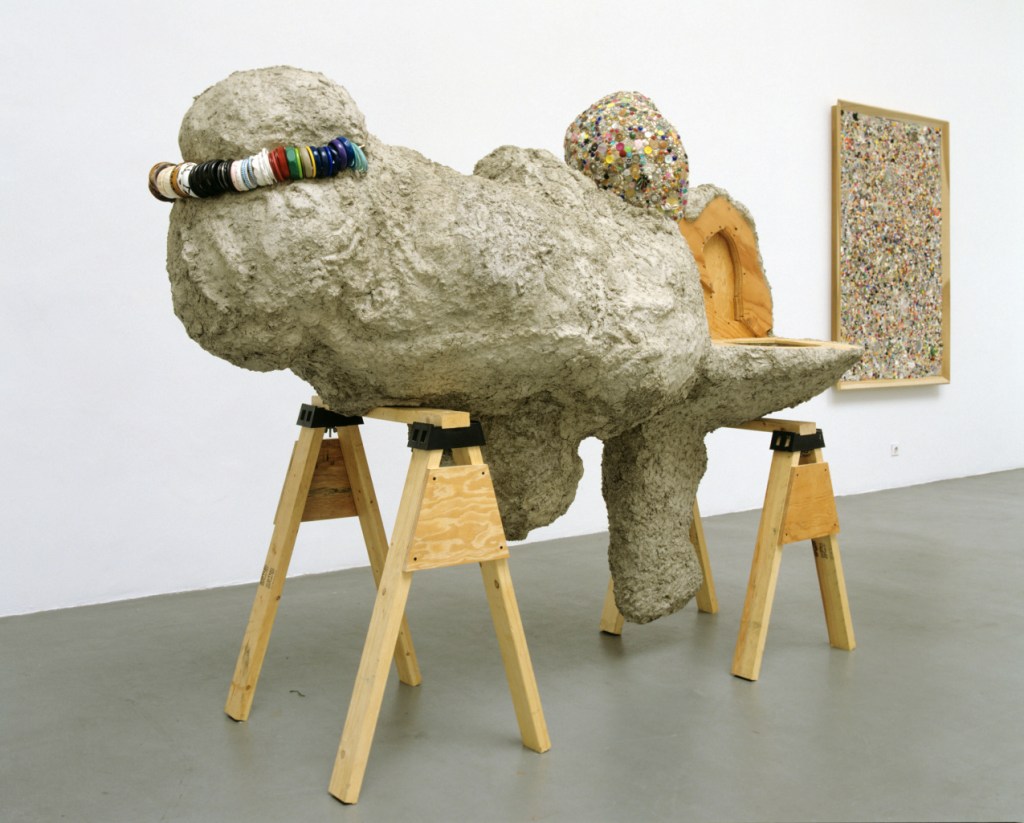
American artist, Kelley is regarded as one of the most influential artists associated with the Conceptual Art movement. His work explores themes of youth, class, and the divide between high and low culture. His art is both playful, childish and disturbing. by using found objects like soft toys and knickknacks in contrast with the exploring the history and nature of the objects the artist investigates societal norms and how we place value on inanimate objects. His work spans across multiple disciplines drawings, paintings, soft sculpture and film.

“I think they’re really standardized kinds of repressed things in the culture—embarrassing things, like sexual dysfunction and the scatological,” he once said of his subject matter. “I started seeing throughout my work that a lot of these traditional, low comedy forms and subject matters were operating. I wanted to start to deal with that in a more conscious way.”

Kelley often assembled works of different media into installations of various constituent parts. In doing so, he helped to debunk the traditional expectation that the artist must be a master or expert of a particular medium. Instead, the unifying factor in many of Kelley’s heterogeneous installations and sculptures became above all conceptual rather than formal. His use of soft materials and how he repurposes objects is something i’m really interested in and am exploring in my own work. object making and adding meaning and context to inanimate objects is something iv explored and thought about a lot throughout my project.

Annette Messager
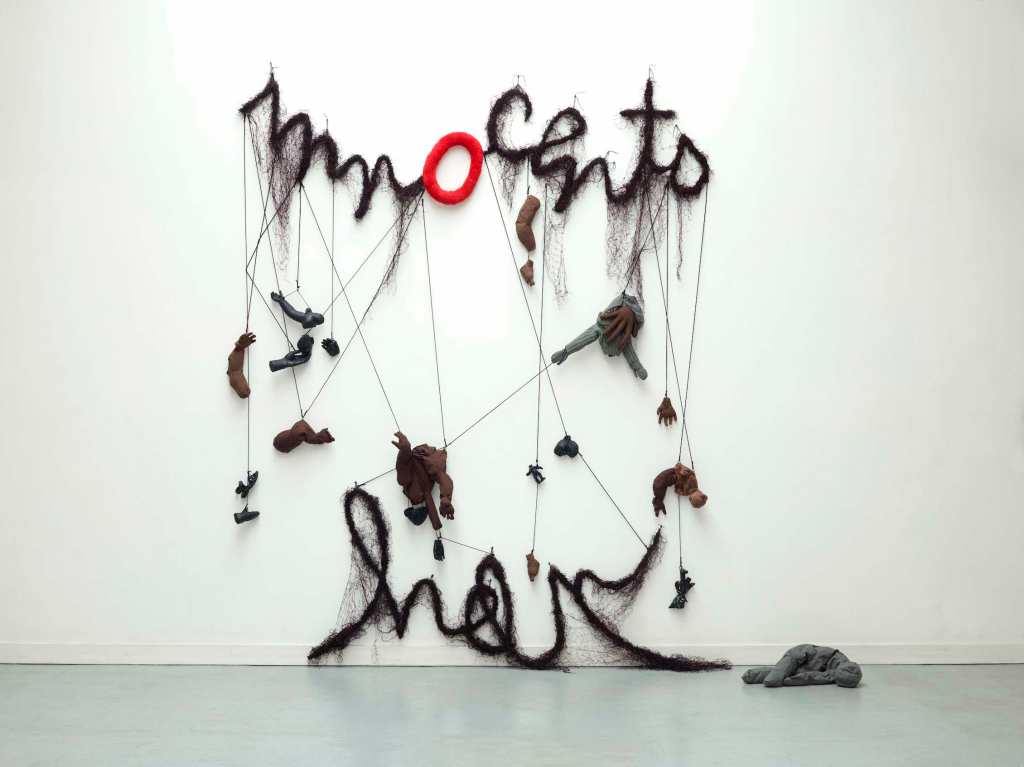
Born in 1943 in France, Annette Massagers work focuses on the perceptions of women by individuals and by society as a whole. Her earlier work focused on domestic objects such as textiles, toys, and found objects similar to the materials and things i am investigating in my current project. She consistently continues to question traditional notions of femininity and masculinity. “At first, I felt proud when someone said, ‘Your work looks like a man did it.’ Then I realized that was stupid,”

The Pikesis‘ is an instillation comprises an arrangement of more than a hundred long, spiked poles or ‘pikes’, propped up against two adjacent walls, each of the pikes either supports or impales a variety of objects as well as images. Small bodies made from doll parts, stuffed limbs, headless torsos and internal organs are placed in tights, or pierced by pencils and hung with images of torture instruments along side their victims. Other pikes show colourful drawings of limbs and figures as well as maps showing various contemporary political entities in Africa, Europe and the Middle East.

Messager’s used a wide variety of techniques and materials using photographs, drawings, text and found/made objects, embroidery, knitting and painting. Her works explore expectations of power in the relationships between male and female, vulnerability and aggression. ‘Pikes‘ a time when chaos and disorder is briefly allowed and the boundaries between civilised and uncivilised actions blur. “Showing parallels between the potential cruelty of children’s play and that of modern social and political structures, using a combination of pathos and violence. Evoking sympathy while suggesting sadism, her objects and imagery illustrate the paradoxical complexity of human relations on both personal and political levels.”

This contrast of using soft ‘innocent’ traditionally feminine materials in a serious and brutish context agin is something i’m interested in and have explored throughout this project.
Secrets: Artist Research

Jenny Holzer

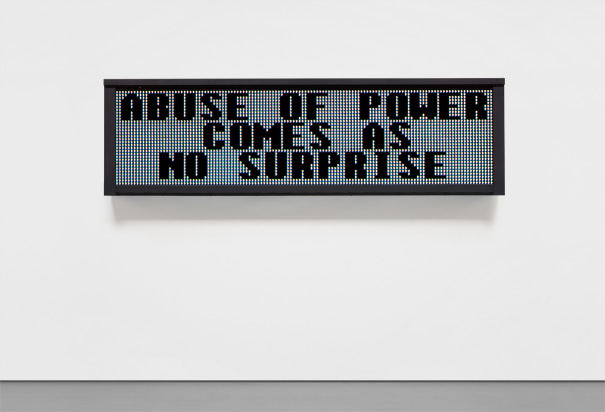
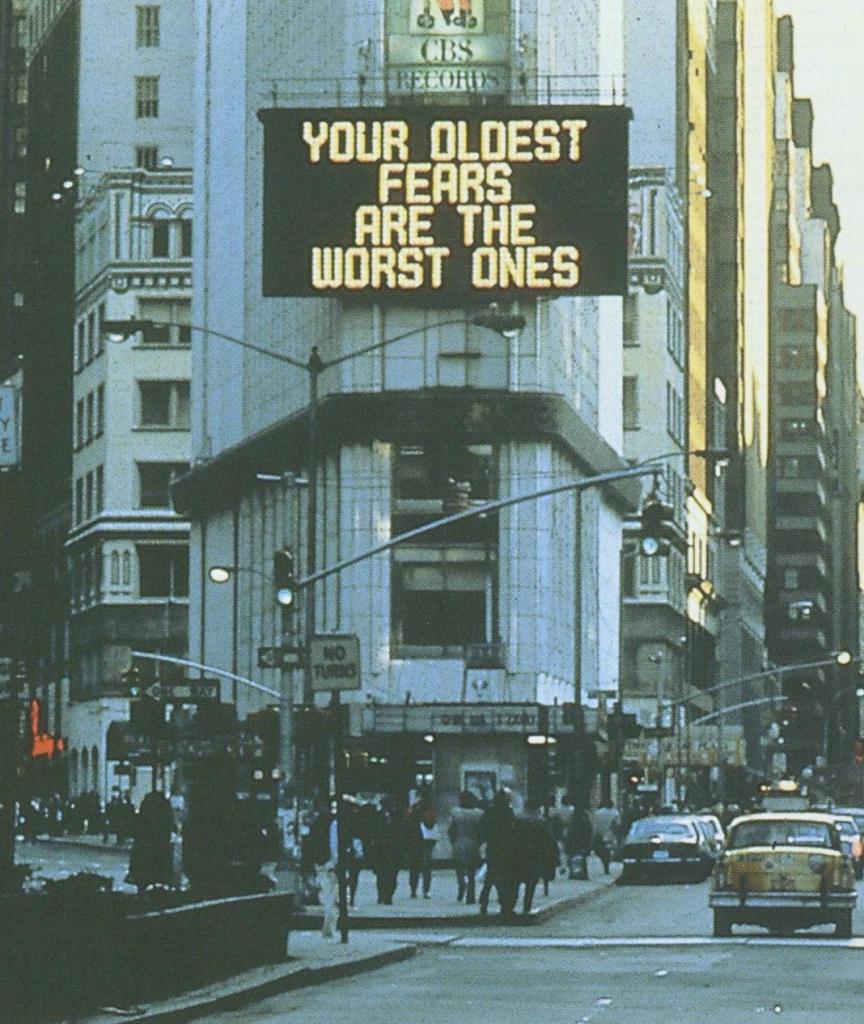
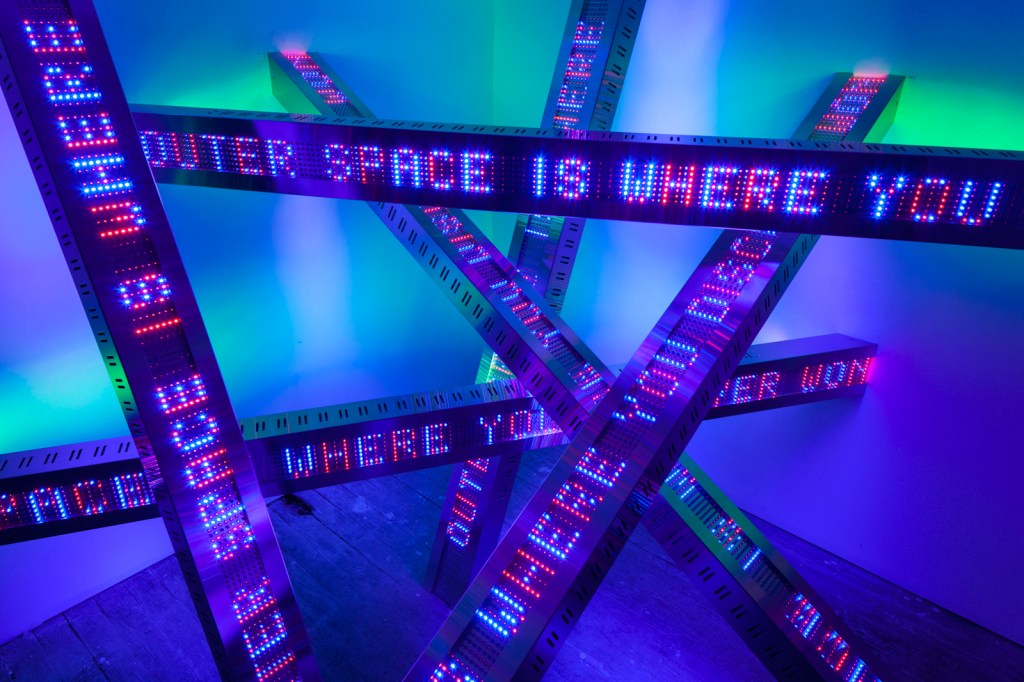
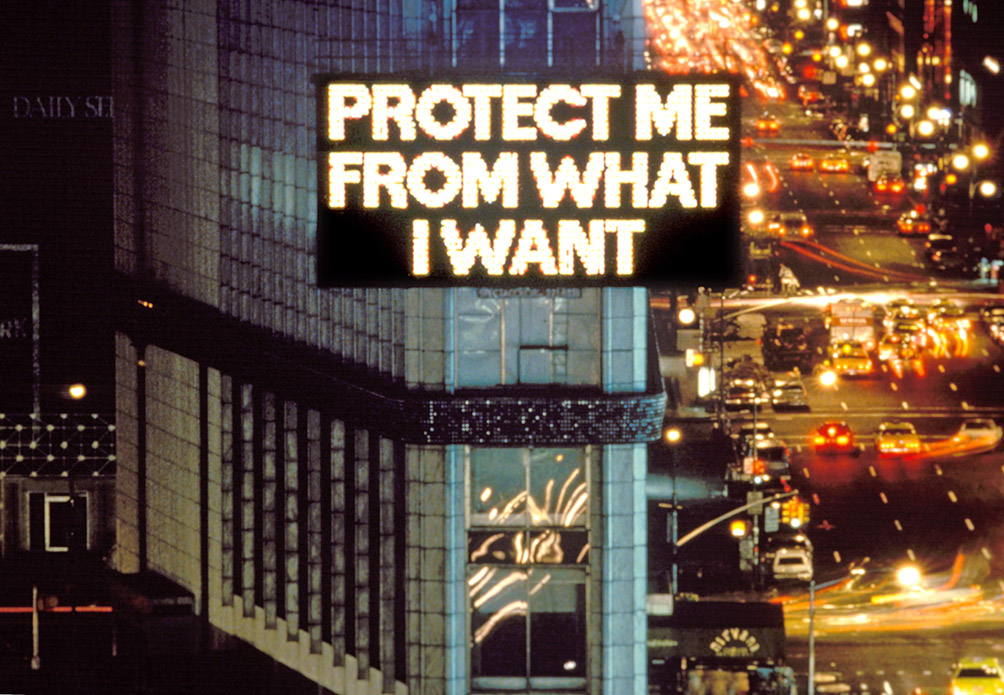
The artist was born in America 1950 as is based in new york. The main focus of her work being delivering messages using text in public space. Here conteporarys include artists like Cindy Sherman, Barber Kruger and louise lawler. She is associated with the feminsit artist that emerged in the 1980s. The public apperance and grand scale of her work is crutual to her practice as well as using projections prints and neon text. Although her diverse practice incorporates a wide array of media including street posters, painted signs, stone benches, paintings, photographs, sound, video, projections. Her work pollutes and takes over structures using this mass media asthetic of being oversaturated and VERY public. her work is directed at the casual viewer rather than gallery visitors. Her bringing her work ou into public spaces i find the most interesting. exposing her audience rather than inviting them. I want to incorporate this elemnt of playing with the idea of audience; who and where am i trying to engage. Using text as a way to ingage the viewer is also something i want to experiment with.

Christopher Wool

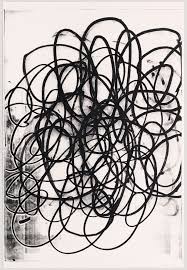
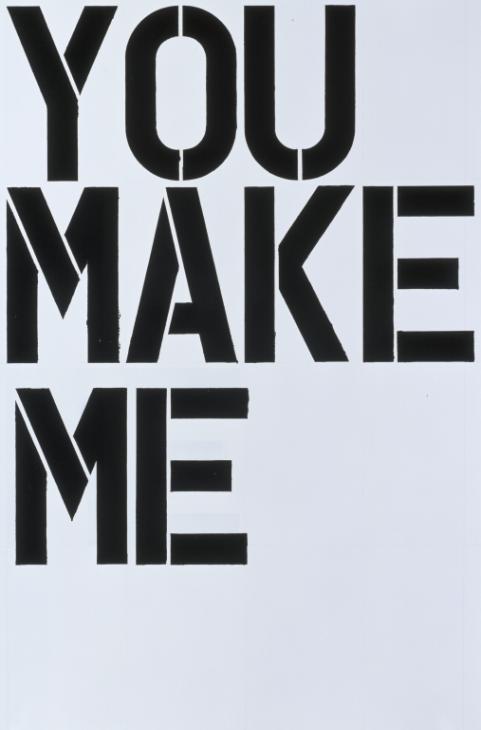
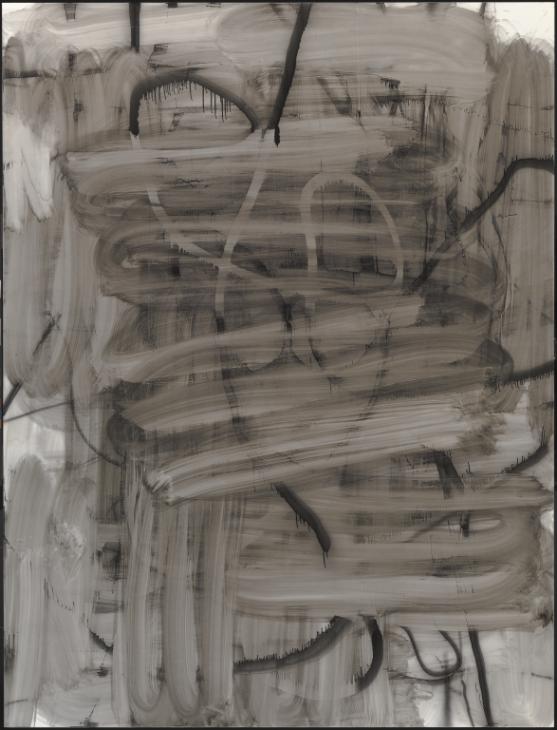
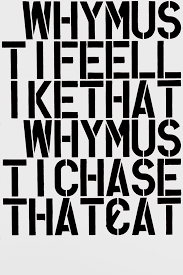
American conceptual artist who is based in New York. He I best known for his paintings of large black letters on white canvases. These works began in the late 1980s inspired after seeing black graffiti on a new white truck. The words tend to be broken up by grid system or have the vowels removed so much so that they often need to be read aloud to make sense. Although he is best known as a painter he has a large body of black and white photography of the streets of Chinatown. I like the straight forward and confronting attitude the artist’s work has. This quite literally black and white message leaves not much to be debated in terms of meaning and message. Forcing his audience to read and understand. 

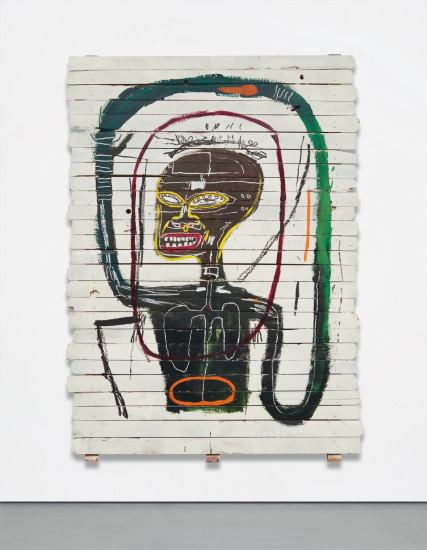
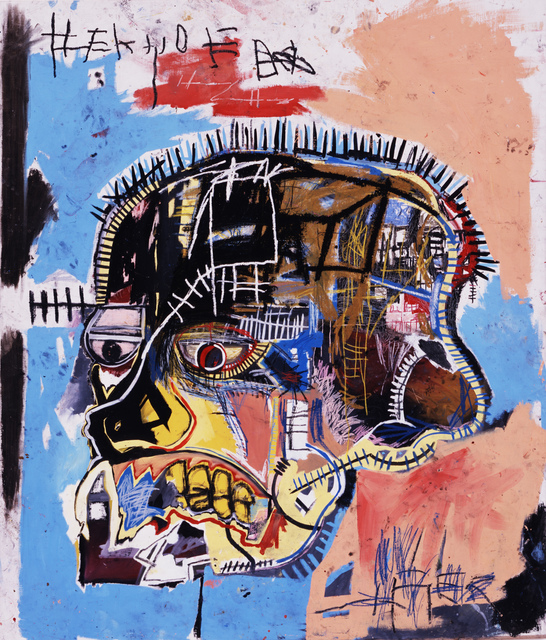
Jean Michel Basquiat

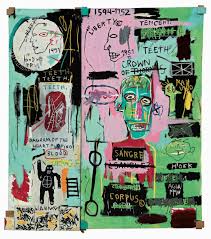
Jean-Michel Basquiat was born in 1960 in America. He started his practice as an informal graffiti artist in the late 1970s where the artist was influenced by early hip-hop music culture. He then started his Neo-expressive paintings in 1980 where they began to get attention and exhibited at galleys and museums internationally. His art focused on themes of wealth, poverty and immigration. He worked with a range of media poetry, painting, drawing and married text and images amount abstract figures. He also repeatedly mixed historical information with modern social commentary. He used his art to attack power structures and make his audience question systems of racism. This engagement and again confrontation with audience is something I want to focus on.

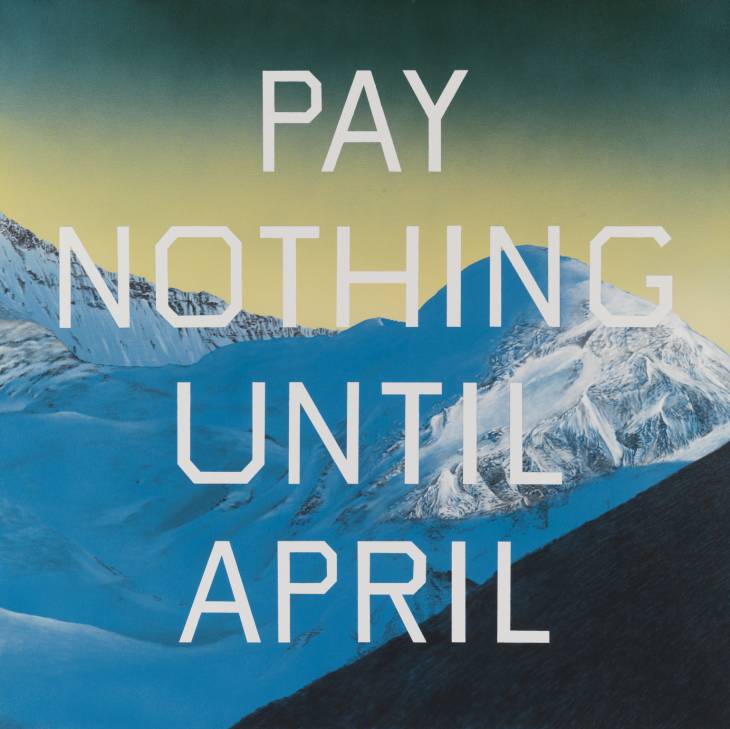
Ed Ruscha

Born in 1937 in America the artist is associate with the pop art movement. He worked with very mixed media of painting, printmaking, drawing, photography and film. His early career and education was rooted in commercial art and advertising. His very first word painting was displayed in 1961 and since then the artist has included text within his work. These phrases are often comical and simplistic. These phrases often “just occurring” to the artist almost as just a passing thought or phrase that can be interpreted in a multitude of meanings. Experimenting with humorous sounds and rhyming word plays, Ruscha made a portfolio of seven mixed-media lithographs with the rhyming words, News, Mews, Pews, Brews, Stews, Dues, News in 1970. Again, using text in a short and pushy manner I find really effective and think I am going to experiment with and use within this project. 

All of these artists are asking questions at their audience whether that is very publicly or in an art gallery setting. Question who you audience is and how you are going to reach them is something I’m going to explore more in this project using text and imagery. 

Conceptual: Artist research

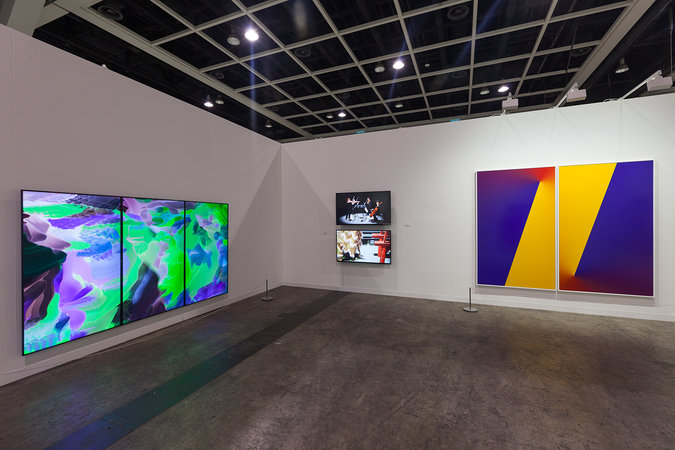
Samson Young

Born in 1979 This artist lives and works in Hong Kong originally trained as a composer his artwork now takes for in a range of media’s. His work discusses themes of identity and conflict without suggesting solutions or interrupting the current social and political climate. He constantly questions our understanding of information and how we process things, specifically how we interpret sound. His work is also frequently political in nature, addressing military history and the British occupation of Hong Kong as subjects. He manipulates the components of music – sound, beat, rhythm, resonance – to communicate global issues surrounding topical conflicts that have affected our past and present as well as future.

I like the artists diverse approach in that he doesn’t excel in just one are a media rather each relies on the next to show the completed story and theme. However I feel his sound pieces to me are the most compelling, specifically “Liquid Borders” (2012-14), where the artist visited restricted zones along the Hong Kong-China border recording the sounds of the divide. Recording the vibrations of the fence at multiple points from both sides, showing that the sound of the fence remained the same from both sides. These recordings were made into sound compositions then transcribed into graphic notation.

Martin Creed

Martin Creed was born in 1968 and is a British artist, composer and performer. He uses ordinary inexpensive materials in order to create multimedia works that have both irritated and delighted viewers and critics. Despite his reputation as a conceptual artist he rejects the term “conceptual” and calls himself an “expressionist,” referring to his notion that all art stems from feeling. His work ranges from minimalist interventions, expressionistic portraits and songs. His approach to art always holds humorous undertones and experimentation. He is constantly underpinning everything he does with the open question about what art is.

See the source image

Bruce Newman

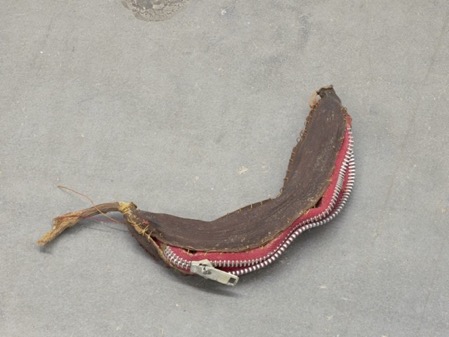
Bruce Nauman was born in 1942 in America. Nauman finds inspiration in the activities, speech, and materials of everyday life. Despite the impact of Dada, he has continued to view his art less as a playful or creative enterprise than as a serious research endeavour. Nauman’s earliest work was shaped by Minimalism in the late 1960s. In particular, the way he treated his own body in his work, shown in video completing repetitive tasks – and the way he related the body to surrounding objects show the impact of Minimalism’s new ideas about the relationship between the viewer and the sculptural object. But he often rejected the slick production values of Minimalism and has often showed a preference for a cruder rawer presentation of work.
See the source image

Richard Billingham

(born 25 September 1970) is an English photographer and artist, film maker and art teacher. His work has mostly concerned his family, the place he grew up in the West Midlands, but also landscapes elsewhere. He began taking photographs of his family in their council flat in 1990 to use as studies for paintings. However when he exhibited the photographs as works in their own right, they quickly brought him to the attention of the art world. His photographs have been hailed as a mass of contradictions and praised for their lack of condescension. They are an unique and highly personal document of working- class identity in Britain, showing a ‘warts and all’ look at the life of Billingham’s family.

See the source image

3D CONTEXT: ARTIST RESEARCH

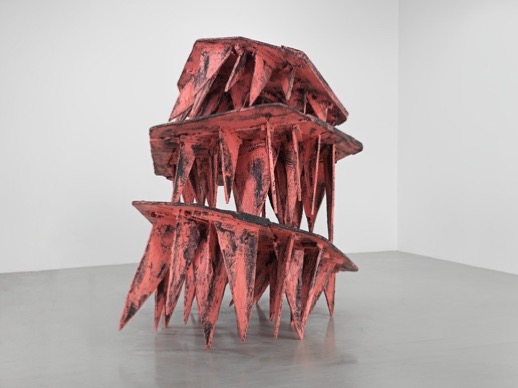
Phyllida Barlow


Although born in Newcastle upon Tyne in 1944 Barlow was brought up in a London where she studied at Chelsea College of Art (1960–63) where she was able to learn that the act of making was in itself an adventure. A sculpture that falls over or breaks is just as exciting as one that reveals itself perfectly formed. All the acts of making are valid. She creates work with the intention of making something larger than herself, reflecting and contrasting with her environment as well as attaching new meaning and purpose to existing material’s. She also explores the relationship between her work and space it occupies. She repeatedly questions whether the space dominates the work or the work dominates the space.

I like the artists use of scale and playfulness, her work is almost childlike and messy never appearing truly finished or polished. Her careful and exciting use of bold colours also add to the child likeness of her work. The sculptures and instillations encourage the viewer to move round and through it from all angels. The artist uses the space to its full potential and considers every aspect of the space it will fill. I also like the artists inexpensive use of materials such as cardboard, fabric, timber, polystyrene, plaster, scrim and cement.

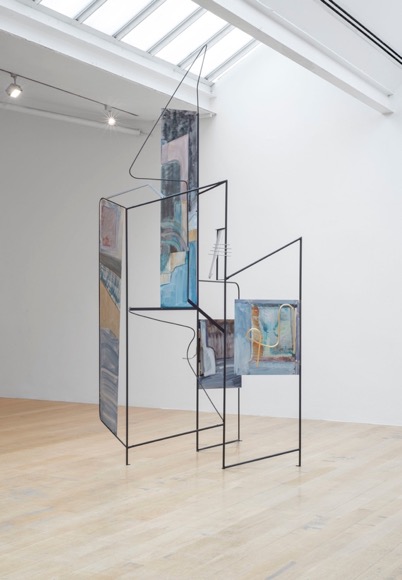
Sara Barker

Sara Barker was born in Manchester in 1980. She studies at Glasgow School of Art in the city of Glasgow where she now lives and works. The artists work braks the boundaries between painting and sculpture. Skeletal structures in aluminium and steel presented in wonky rectangular shapes with contrasting lines, as though uncertain of themselves. Their surfaces are then coated with layers of oil paint, gouache and watercolour. The artists colour pallet resembles that of a landscape watercolour. Barkers work evokes ‘that top-heaviness and precariousness’ of sketching in three-dimensional form. As such, her combinations of bespoke materials challenge traditional perceptions of structural solidity, the lightest often providing the weightiest support for the basis of the sculpture”. Her liminal streaks of colour provide what she describes as ‘cracks in a door’ or glimpses into another realm. Her sculptures are completed by the spaces in which they are installed by implementing the negative space around them; resulting in abstract  dream-like sequences of materials.

I find this artists combination of materials the most interestin, using each to their full potential as the colours of the paint always compliment the light and the space in which the work is presented. Also the artist’s use of shape and how these large geometrical forms ply and interact with the surrounding environment.

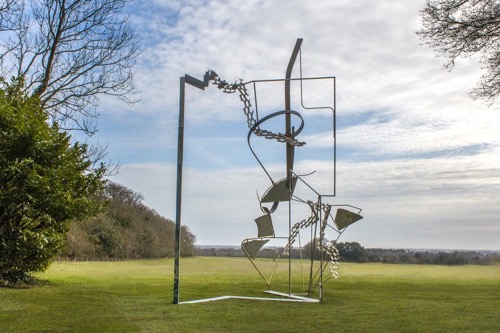
Zoe Leonard

Zoe Leonard (born 1961) is an American artist who works primarily with photography and sculpture. The now New York based artist merges photography, sculpture, and installation. By employing strategies of repetition, shifting perspectives, and a multitude of printing processes, the artists practice probes the politics of representation and display as well as exploring themes such as gender and sexuality, loss and mourning, migration, displacement, and the urban landscape. Her photography work invites the viewer to contemplate the role that the medium plays in contributing to history. Her work always encourages the viewer to reconsider the act of looking itself, presenting it as an ongoing process.

I like this artists work as she explores interesting diverse themes such as societal roles, gentrification, injustice and daily life. This makes us the viewer reflect our own environments and behaviours. Her sculptural work always inhabits the space in an almost non-invasive way. It is almost presented neatly like a passing idea or question.  This further engages the viewer to think of her work outside of a gallery context and within the real modern world.

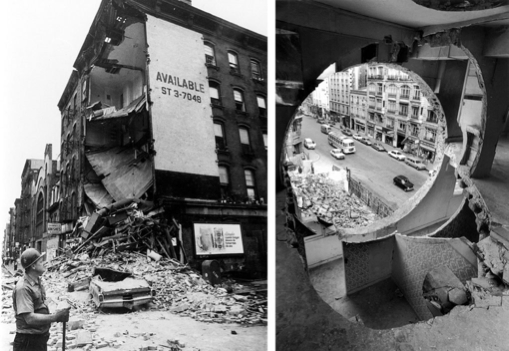
Gordon Matta Clark 

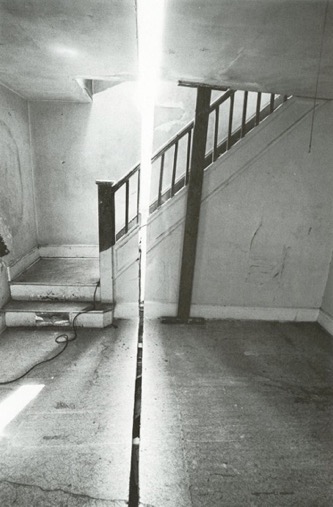
Gordon Matta-clark was born in 1943 in America and trained originally as an architect. He is best known for his spectacular ‘building cuts’ that are often seen as an outright rejection of the architectural profession. Dealing with themes of metamorphosis and resistance towards the commodification of art, he went on to study architecture at Cornell university from 1963 to 1968, where he met Robert Smithson who influenced his interest in using non-art materials. Moving back to New York, he experimented with both food and photography as well as documenting the burgeoning graffiti-scene and the sewers and subways of the city. 
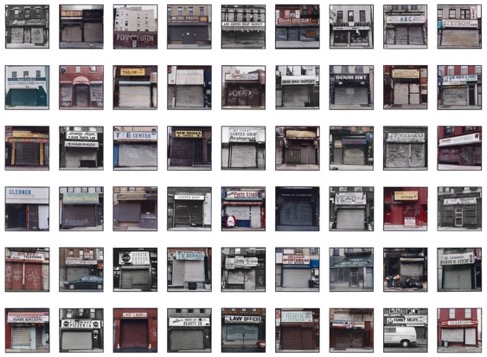
I find the artists use of medium the most interesting as well as his use of space. His ‘building cuts’ are site specific and his work was often illegal and destroyed directly after completion. This element of impermanence to his work is interesting also, the idea of creating something just to have the intention of destroying it. The impermanence i find playful and it makes his work somehow feel more special and outlandish.
Helen Chadwick: Piss Flowers

HND CONTEMPORARY ART PRACTICE (CAP 1) 

Helen Chadwick: Piss Flowers

The artist creates a humorous atmosphere while still maintaining her overall themes of the natural world. Her I find her use of materials the most interesting the process of making the work (casting the interior spaces left in the snow by urine). The contrast of taking such a natural process and trying to capture and solidify something so impermanent and unimportant as urine. I think the artist was trying to communicate the importance of detail within everyday life and how beauty and brilliance can be extracted from the simplest thing. 

Helen Chadwick was born in 1953 in Britain and became one of the first women artists to be nominated for the turner prize. She is best known for challenging and exploring the body in unconventional methods. Her work ranges from themes of science, myths, beauty, identity, femininity and the human body/form. She was associated with the feminist movement in the 1970s, specifically her earlier work where she addresses “The issue of the female body as a site of desire”. Her work protested and questioned the objectification of women and examined what exactly was gender and the role it plays in society.

https://www.richardsaltoun.com/artists/101-helen-chadwick/biography/

https://www.tate.org.uk/art/artists/helen-chadwick-2253

https://www.artscatalyst.org/artist/helen-chadwick

https://www.jupiterartland.org/artwork/piss-flowers

https://fineart.ac.uk/works.php?imageid=bt0005

MODERN GALLERY VISIT

4/9/2019

Modern 2: Cut and Paste Exhibition

The exhibition focused around the history of collage and how it has been interpreted and used by different artists over time. I don’t often use college in my own practice but still found it to be enjoyable and gave me new ideas on how I could approach using it. The thing that struck me the most was the huge volume of work ranging from each decade and how the method changed and evolved over time.

The artworks and artists I found were the most interesting from the exhibition were the ones associated to the feminist movement. Particularly the work of Hannah Höch and Hannah Wilke.

Related image

This collage is from a series of seventeen photos created and shown between 1924 and 1930. It layers and incorporates photographs of a baby body, a tribal mask and an eye from a magazine. It combines a multitude cultures each image bringing another layer of meaning to the piece. The hybrid figure is positioned on small feet, as if it is on display. The work is thought to be an ironic comment on the treatment of women in Weimar Germany. At the time they were being equated with primitive people, and treated as unimportant, while simultaneously being put on a pedestal. The geometric background references the work of the Dutch De Stijl group of modernist artists and architects, with Höch was associated with at the time.

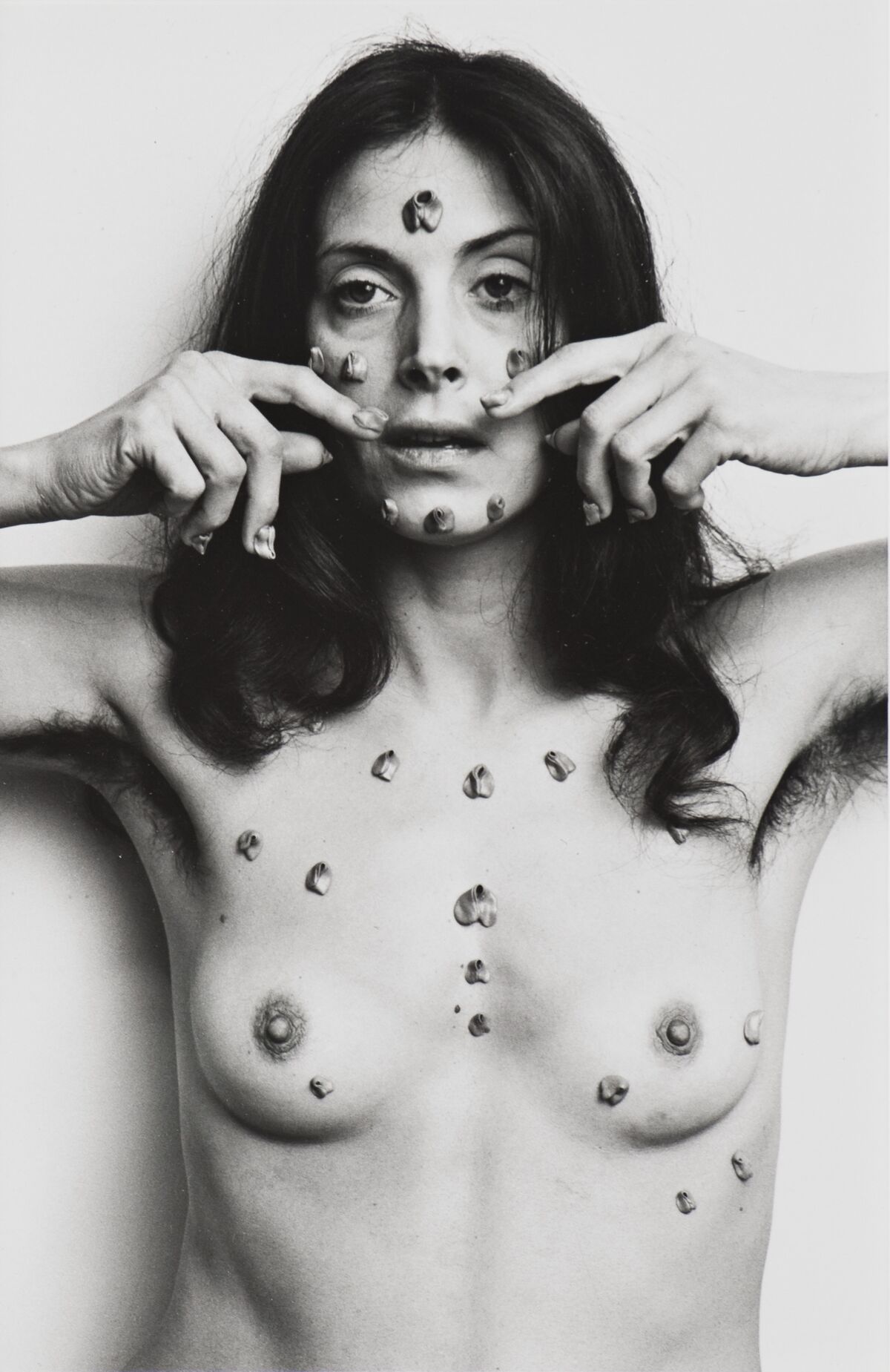
Hannah Wilke, S.O.S. Starification Object Series, 1974. © Marsie, Emanuelle, Damon and Andrew Scharlatt, Hannah Wilke Collection & Archive, Los Angeles. Licensed by VAGA at Artist’s Rights Society (ARS), New York, DACs, London. Courtesy of Hannah Wilke Collection & Archive, Los Angeles and Alison Jacques Gallery, London.

This work is taken from the S.O.S. Starification Object Series (1974-1975)
The artist explores stereotypes of the female body. She draws attention to the objectification of women in both art and pop culture. Using her own body put her at the cutting edge of performance art at the time, but her work was sometimes misread by critics as a celebration of her own beauty rather than the objectification of. The artist used a wide range of media; and her experiments with non-art material were not unusual for the time. This included: gum, erasers, chocolate, play-doh, cookie dough, and dryer lint.
Wilke’s work was a significant influence of feminist performance art of the 1970’s. Her work was also associated with postmodern art because of her rejection to fine art materials and how she challenge to traditional definitions of not only art but female art.

Modern 1: Here and Now

Image result for anya gallaccio roses edinburgh

The gallery excited the work of Anya Gallaccio, who is known for creating site-specific installations. She is also known for using organic materials as her working medium and often in large quantities, such as chocolate, whistling kettles, ice, sugar, candles, salt, Polaroid photographs and lead, she conveys the nature of change through the passage of time, the balance in life struck between growth and decay.

‘Red on Green’ shows the decay and destruction of 10,000 red roses laid in a rectangle upon the gallery floor. The Roses themselves are Fragrant, soft and velvety they have positive connotations of romance and decadence. However, over time they are slowly allowed to blacken and die. The sharp thorns and stems that lie underneath the petals are a reminder of death and the fragility of life and ageing. I liked the artists use of materials and the contrast of life and depth that is slowly revealed over the course of time. I find the ageing aspect of the work the most interesting making you question how you feel about the ageing and developing process. Her work often deals with these complicated themes of love, death,romance,aging, and youth.

“The extravagance of a pile of roses, which have their heads pulled off as an aggressive and obsessive gesture, along the lines of ‘loves me, loves me not”, is a passionate thing, but isn’t intended to be sentimental”

Image result for charles avery untitled diarrhea projection

The exhibition also showed the work of Charles Avery who is a Scottish artist from Oban. The work he is most renowned for is work entering around the description of an imaginary island through the use of drawings, sculptures and texts. The artists describes it as “The topology, cosmology and inhabitants of this fictional territory, from the market of the main town Onomatopoeia to the Eternal Forest where an unknown beast called the Noumenon is held to reside. The project can be read as a meditation on some of the central themes of philosophy of art-making, and on the colonization and ownership of the world of ideas.” This work like others from this exhibition focuses on themes of change, growth and decay.

The thing I find most interesting in this work is the theme of illusion running through it as well as how mesmerising the projection itself is to watch. The wings of the creatures are so thin and they reproduce and disappear by chance when they overlap and another. At some stage they flutter out of the box becoming larger before finally evaporating.