My theme for the project progressed from being about memory the focusing on the reliability and authenticity of memories. I focused on the 3 stages in which we take in and digest information. The sound work I originally produced at the beginning of the project I felt like was veering away from the theme of memory to much so to bring it back I included me telling the memory over the door and window stuff I was working on beforehand. I began by thing of memory’s and attaching imagery of the homes and houses as my research developed a lot around the idea of creating a memory palace and for this you need somewhere which you are familiar with – home. I focused on these images of doors, windows and the basic house structure; like something you would draw as a child. I think keeping the simplicity of just having lines made my insula responses easier to understand and connected with more people in crits. I used tape and pen to create these images as it was quick and got the basics of what I wanted to show without going into too much detail. Using the tape, I could also but the door and window anywhere- in college, at home, outside. I also started experimenting with sound after looking at the work of samson young. I experimented with recognisable sounds and slamming of doors and windows. This was as quick and easy to transfer and edit just using apps and my phone it was also exciting as I had never messed around with anything like that before. I could have considered the final piece a bit more as ideally I would have liked it to be a performance piece of me telling the viewer a memory form one side of a door. I think just having the audio play from my phone was a bit clumsy looking and I could have presented it better. My time management could have been better as I could have played around with using video and experimented more with what the memory was and how it was delivered to the audience. I would have focused more on the memory I was reciting and the mood and tone which I was delivered with, also played around more with audience and not just played it to people I know but maybe strangers as well.
Tag Archives: Conceptual
Conceptual: Development 2
continuing on from the idea of having a place to store memories i researched into storing sound memories (echoic memories). This is where your brain registers specific auditory information lasting between 2-4 seconds. I then listed sounds only I would recognise – My door bell, the doors slamming in my flat, the noise of someone closing a window, specific floor boards the creek ect. I listed sounds connected to my house to link it back to the idea of creating a memory place (a place I know very well). I like the idea that the sound relies on your understanding of what is is to exist and be understood and listening itself is driven by a desire to understand something/someone else. We slot or organise what we hear into a known category automatically without thinking.
I then went on to researching the work of Samson Young and Florian Hecker. Both artist use sounds and audio editing to make us question our understanding of our surroundings.
So I wanted to mimic this questioning of someone retelling a memory and questioning what parts are easy to understand and what parts and interrupted and unreliable. My plan was to play around with the sounds within my house to create this feeling of being shut out or unrecognisable. using sounds only I would recognise to create something non authentic and something other people couldn’t pick apart and couldn’t understand these nosies or where they might be from.
Link to audio: https://vimeo.com/user94451701/review/389491917/14cabc7b50
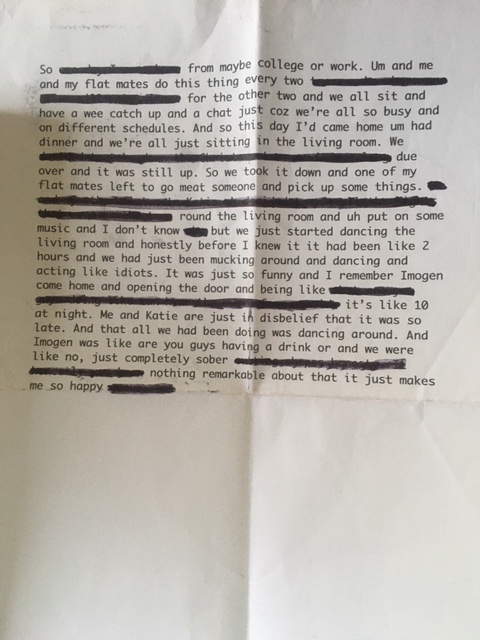
However i felt like this idea of the sounds within my house was moving away from the idea of memory so I instead recorded myself recalling a memory that happened in my house in the room i happened in then had someone open and close the door through my telling of events. The door opening and closing represents the coming and going of information and how you can let someone in on a memory and shut someone out. You also have the ability to not let anyone in at all – keep them behind the door. i wanted whoever was listening to get that feeling of being excluded from my memory or that feeling of being shut out. I also tried this using the 2 windows to the room but the audio from outside on the street i felt was too distracting. I liked the noise of the door itself as a door alone represents the coming and going of a person through to a different space – memories coming and going.
link to audio: https://vimeo.com/user94451701/review/389496827/bfee173d1b
I also took recordings of me just telling the memory with the door closed and open, with the audio recorder on both sides of the room, with the recorder cutting off at so points, all in an attempt to obscure the memory and make the audience question each part of what they are hearing. I liked this idea of them having to put the puzzle together themselves.
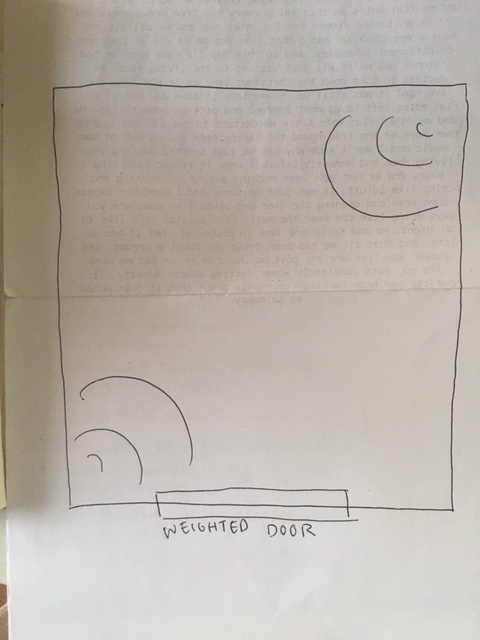
I then started playing with the idea of cutting up the audio and rearranging what part you would hear in each part of the room again making the audience work to collect and gather the full story rather than having me just tell them the memory straight.
Thinking about presentation i also considered having it be played in a small intimate room where there was a weighted door so the audience could decided what parts of the audio they where abele to hear and weather or not they wanted to come into my space and here me talk or simply would only open the door and listen for a moment.
FINAL OUTCOME
Conceptual: Artist research
Samson Young
Born in 1979 This artist lives and works in Hong Kong originally trained as a composer his artwork now takes for in a range of media’s. His work discusses themes of identity and conflict without suggesting solutions or interrupting the current social and political climate. He constantly questions our understanding of information and how we process things, specifically how we interpret sound. His work is also frequently political in nature, addressing military history and the British occupation of Hong Kong as subjects. He manipulates the components of music – sound, beat, rhythm, resonance – to communicate global issues surrounding topical conflicts that have affected our past and present as well as future.

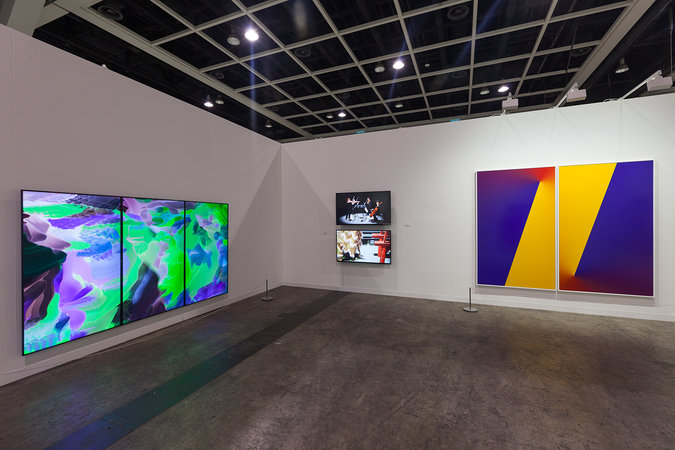

I like the artists diverse approach in that he doesn’t excel in just one are a media rather each relies on the next to show the completed story and theme. However I feel his sound pieces to me are the most compelling, specifically “Liquid Borders” (2012-14), where the artist visited restricted zones along the Hong Kong-China border recording the sounds of the divide. Recording the vibrations of the fence at multiple points from both sides, showing that the sound of the fence remained the same from both sides. These recordings were made into sound compositions then transcribed into graphic notation.
Martin Creed
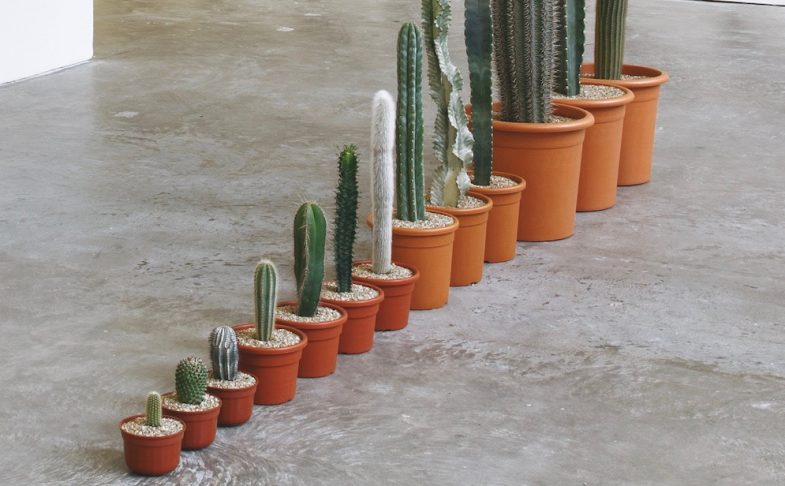
Martin Creed was born in 1968 and is a British artist, composer and performer. He uses ordinary inexpensive materials in order to create multimedia works that have both irritated and delighted viewers and critics. Despite his reputation as a conceptual artist he rejects the term “conceptual” and calls himself an “expressionist,” referring to his notion that all art stems from feeling. His work ranges from minimalist interventions, expressionistic portraits and songs. His approach to art always holds humorous undertones and experimentation. He is constantly underpinning everything he does with the open question about what art is.


Bruce Newman
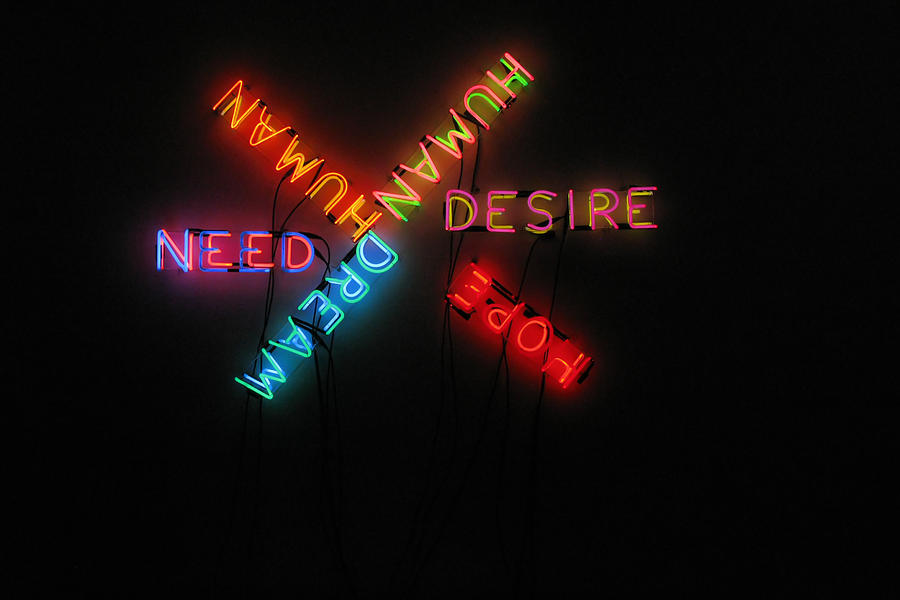
Bruce Nauman was born in 1942 in America. Nauman finds inspiration in the activities, speech, and materials of everyday life. Despite the impact of Dada, he has continued to view his art less as a playful or creative enterprise than as a serious research endeavour. Nauman’s earliest work was shaped by Minimalism in the late 1960s. In particular, the way he treated his own body in his work, shown in video completing repetitive tasks – and the way he related the body to surrounding objects show the impact of Minimalism’s new ideas about the relationship between the viewer and the sculptural object. But he often rejected the slick production values of Minimalism and has often showed a preference for a cruder rawer presentation of work.
Richard Billingham
(born 25 September 1970) is an English photographer and artist, film maker and art teacher. His work has mostly concerned his family, the place he grew up in the West Midlands, but also landscapes elsewhere. He began taking photographs of his family in their council flat in 1990 to use as studies for paintings. However when he exhibited the photographs as works in their own right, they quickly brought him to the attention of the art world. His photographs have been hailed as a mass of contradictions and praised for their lack of condescension. They are an unique and highly personal document of working- class identity in Britain, showing a ‘warts and all’ look at the life of Billingham’s family.


 CHARLEY MILLAR ART